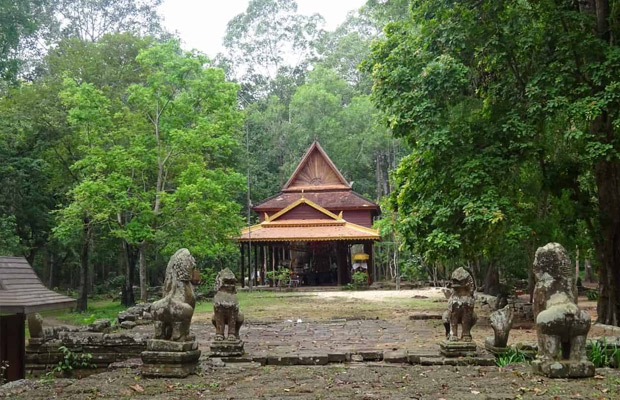
Srah SrangOriginally constructed by the same architect that built Pre Rup. Remodeled in the 12th century as part of Jayavarman VII's massive building campaign. A multi-tiered landing platform on the west edge of the baray is adorned with naga balustrades and guardian lions. The very sparse remains of an island temple can be seen poking out of the middle of the lake during the dry season when the water is low. Srah Srang offers a pleasant, much less touristed sunrise alternative to Angkor Wat. History of Srah SrangIt was dug in the mid-10th century, by initiative of Kavindrarimathana, Buddhist minister of Rajendravarman II. It was later modified around the year 1200 by Jayavarman VII, who also added the laterite landing-stage at its western side, probably because the East Baray had been overwhelmed by sediment and had begun malfunctioning. French archeological expeditions have found a necropolis close to it. The Site of Srah SrangAt present Srah Srang measures 700 by 350 m and is still partially flooded. As other barays, maybe there was a temple standing on an artificial island in the middle of it, as suggested by finding of a basement. The landing-stage, opposite the entrance to Banteay Kdei, is a popular site for viewing the sunrise. It is cruciform, flanked by nāga balaustrades which end with the upright head of a serpent, mounted by a garuda with its wings unfurled. The steps that lead down to the water are flanked by two guardian lions.
Tip: Srah Srang always has water and is surrounded by greenery. According to one French archaeologist, it offers at the last rays of the day one of the most beautiful points to view the Park of Angkor.
It was built in the end of the 12th century, by the King Jayavarman VII, dedicated to Buddhist, replica to Bayon style of art. Layout of Srah SrangA majestic platform (landing stage) with leads to the pond. It is built of laterite with sandstone molding. The platform is in the shape of a cross with serpent balustrades flanked by two lions. At the front there is an enormous Garuda riding a three-headed serpent. At the back there is a mythical creature comprising a three-headed serpent, the lower portion of a Garuda and a stylized tail decorated with small serpent heads. The body of the serpent rests on a dais supported by mythical monsters. See map page 70.
You may check more Cambodia Temple Guide...Banteay Prei TempleSprawling, largely unrestored, monastic complex in much the same style as Ta Prohm. It was originally constructed over ... More Detail Chau Say Tevoda TempleChau Say Tevoda is a temple at Angkor, Cambodia. It is located just east of Angkor Thom, directly south of Thommanon ... More Detail Phnom KromPrasat Phnom Krom is approximately 12 kilometers (7 .4 miles) southwest of Siem Reap near the north end of the Tonle ... More Detail Wat Athvea TempleWat Althea, also called Prasat Vat Althea, is a 12th century Hindu temple at Angkor, Cambodia with an active Buddhist ... More Detail Khleangs TempleRectangular sandstone buildings set opposite the Terrace of Elephants, behind the Prasat Suor Prat. ‘Kleang’ means ... More Detail Bat Chum TempleBat Chum is a small temple built by Kavindrarimathana, a learned Buddhist minister of khmer king Rajendravarman, at the ... More Detail |
Full package tour to Siem Reap
More Detail
Play Standard Golf in Siem Reap
More Detail
Siem Reap Angkor Helicopter Services
More Detail
Honeymoon in Siem Reap Angkor
More Detail
Copyright © 2012 Angkor Focus Travel - Great Way to Discover Angkor Tours. All Rights Reserved.
Guest Name: Mr. Mark peachey
Country: Cambodia
City: Siem reap
Number of Person: 7 Persons
Travel Date: 19/05/2013
Pick Up Services: No
Arrival By: -- Arrival By --
Take Tour By: Mini-Van
Book Choice: Kulen Mountain Waterfall Trip